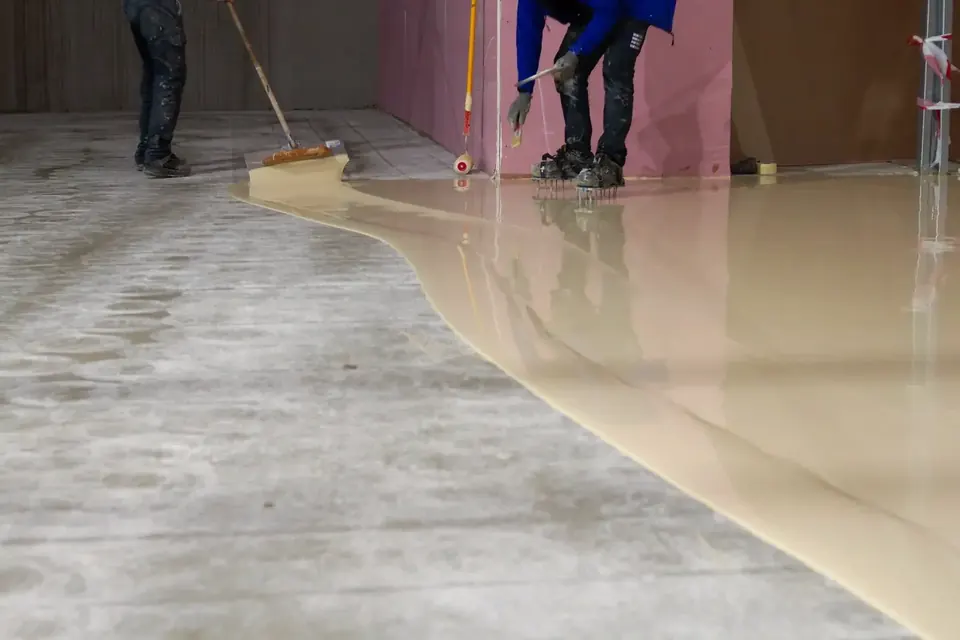
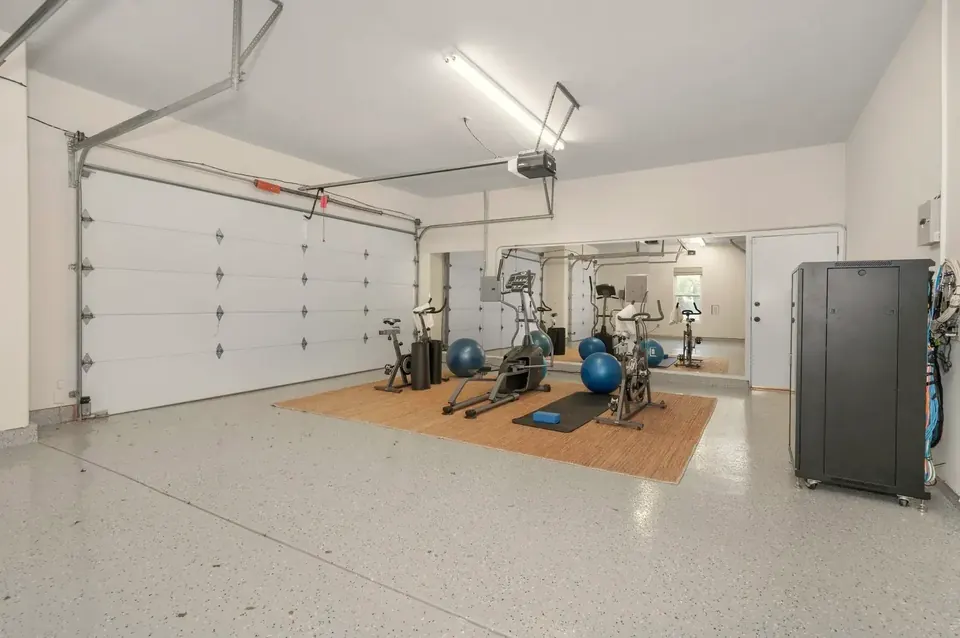
Fast return to service
Walkable in hours and drivable far sooner than all-epoxy systems, which shortens the time your garage or business is out of use.
Free on-site estimate
Tell us about the floor. We'll handle the rest.
Four quick fields. We'll follow up to schedule a visit, look at the slab in person and give you a written price for the system that suits it.
Polyaspartic floor coatings
Polyaspartic is the clear, tough topcoat behind most of our garage floors. It hardens within hours, will not amber in sunlight and stands up to the salt and chemicals that Wisconsin floors see.
01Overview
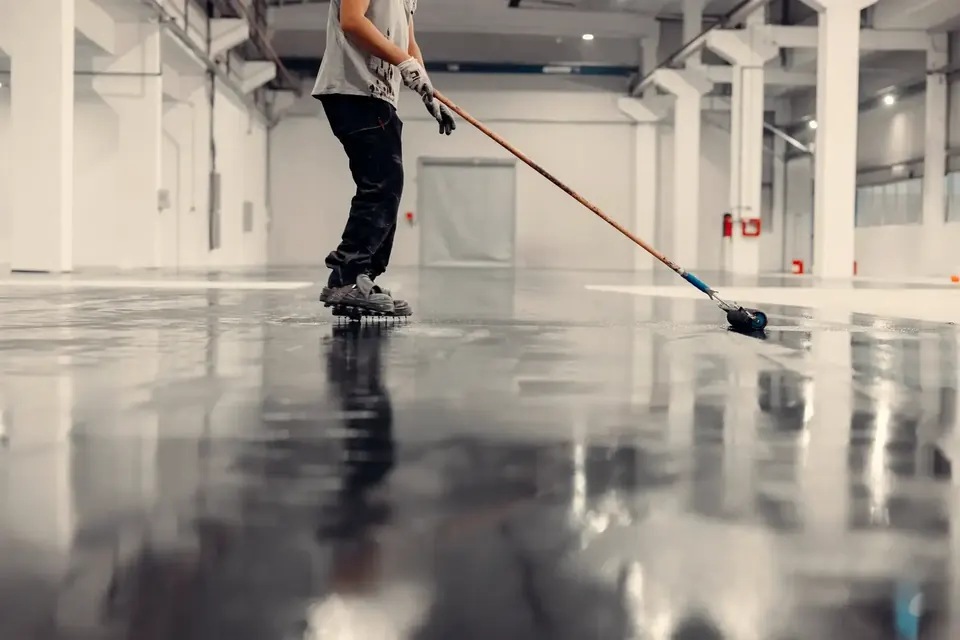
Polyaspartic is a type of aliphatic polyurea. That is a mouthful, so here is what it means for your floor: it cures quickly, it does not yellow in sunlight the way many epoxies do, and it forms a dense film that resists abrasion, hot tires and chemicals. It can also be applied across a wider range of temperatures than many traditional coatings.
On our jobs it plays two roles. The usual one is the clear wear layer over a flake or color system, where its UV stability and toughness protect everything underneath. In some systems it is also used as a base coat, which can allow a full garage floor to be completed in a single long day when conditions are right.
Speed is the feature people notice first. Traditional epoxy systems may keep a garage out of service for most of a week. With polyaspartic, light foot traffic is often possible within a few hours of the final coat, and vehicles can usually return much sooner than with all-epoxy systems. For a family with one garage and two cars in December, that matters.
Speed has tradeoffs, though. Fast-curing material gives installers less working time, so it demands an experienced crew, careful batching and proper slab conditions. It is not a product we would hand to a first-time installer, and it is not a shortcut around surface prep.
02Properties
Walkable in hours and drivable far sooner than all-epoxy systems, which shortens the time your garage or business is out of use.
Aliphatic chemistry resists ambering in sunlight, so the floor near an open garage door stays the same color as the back wall.
Dense, hard film that stands up to foot traffic, rolling toolboxes, snowblowers and the grit that comes with them.
Handles road salt brine, gasoline, oil, antifreeze and most household cleaners when spills are cleaned up in reasonable time.
Many formulations can be applied in cooler temperatures than standard epoxy, which helps extend our installation season.
Excellent clarity makes flake colors and metallic layers underneath look sharp, in gloss or satin sheen.
03Epoxy vs. polyaspartic
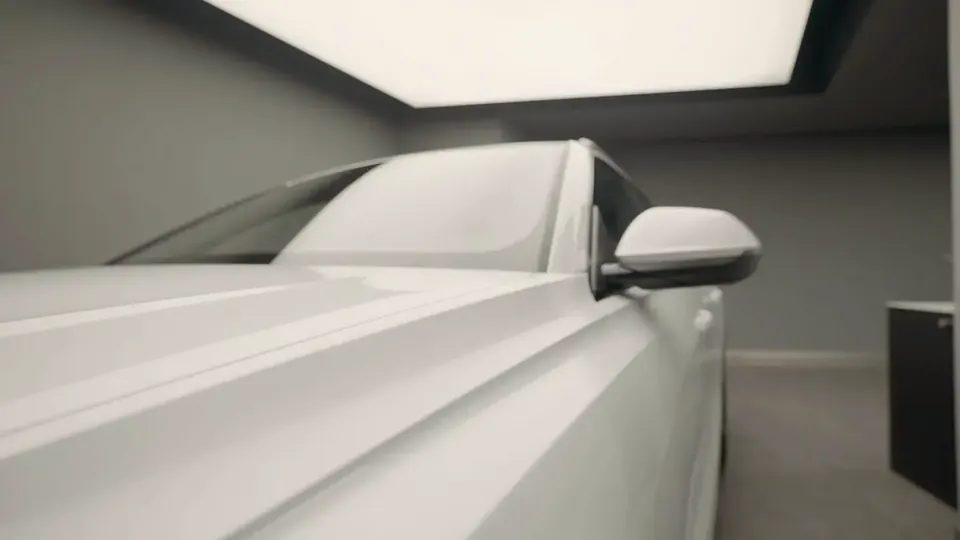
Customers often ask which is better. The honest answer is that they are good at different things, and many of the best systems use them together.
Epoxy is an excellent primer and base coat. It penetrates ground concrete well, builds thickness economically and has a long working time. Its weaknesses are slower cure and a tendency to yellow under UV light. Polyaspartic covers exactly those weaknesses as a topcoat. Combining the two gives you a strong bond at the bottom and a clear, tough wear layer on top.
Full polyaspartic systems make sense when downtime is the main concern, such as a business that must reopen quickly or a homeowner who needs the garage back the next day. We will explain the options and the cost difference so you can decide what matters most.
04Systems
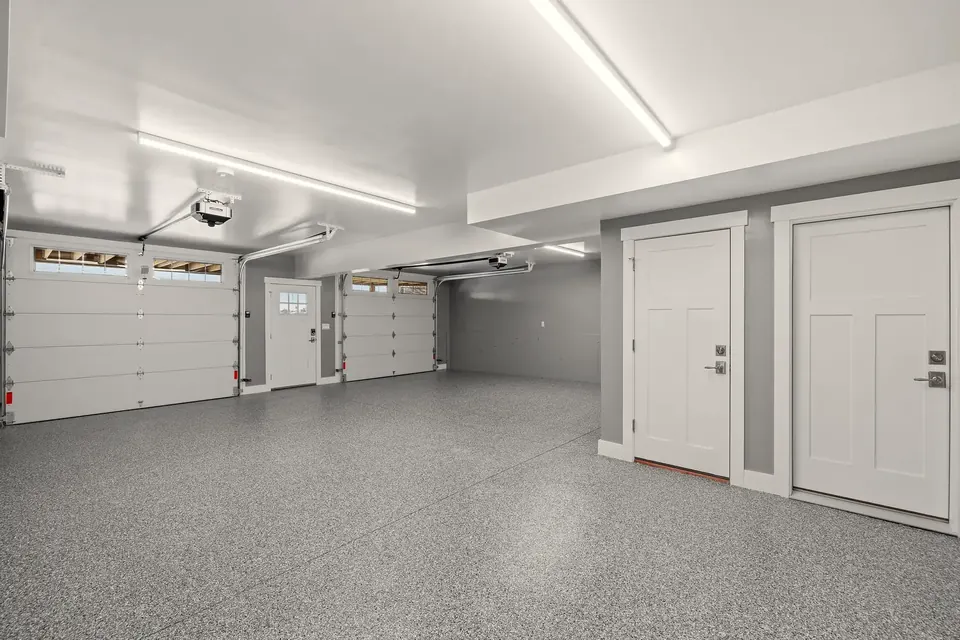 Most common
Base coat, full flake broadcast and a clear polyaspartic topcoat. The standard for garages in our area, balancing durability, texture and appearance.
Fast trackWhen slab conditions and weather allow, a polyaspartic-based system can be ground, coated, broadcast and topcoated in one working day.
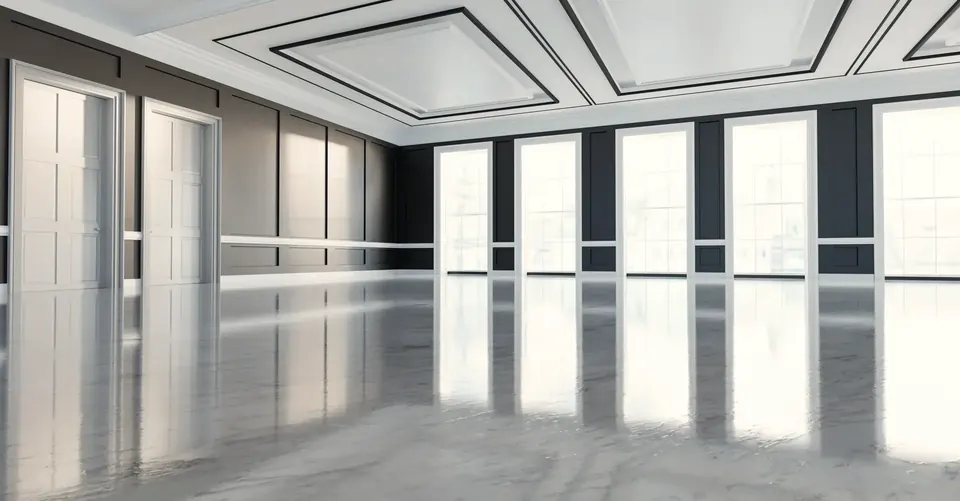 Protection
Applied over solid-color or metallic epoxy to add UV protection and scratch resistance to floors in sunlit rooms, showrooms and lobbies.
05Installation
Fast cure means the order of work is the same as any system, but the pace inside each step is tighter.
Before mixing, we log slab temperature, air temperature, humidity and dew point. Polyaspartics react to moisture in the air, so conditions determine batch sizes and timing.
The slab is diamond ground and repaired. Fast-cure materials leave no room to compensate for poor prep.
Base coat goes down in manageable sections, followed by flake broadcast if part of the system.
Excess chips are scraped and vacuumed thoroughly. Any dust left now will be locked into the clear coat.
Mixed in small batches and applied quickly with a squeegee and roller for an even film and consistent sheen.
06Wisconsin considerations
Several of polyaspartic's strengths line up well with conditions in southeastern Wisconsin.
A dense topcoat with good chemical resistance is the barrier between salty slush and your floor. It is the layer doing the hardest work all winter.
Fast cure helps fit installations into short stretches of suitable weather in spring and fall, and keeps winter garage downtime short.
Humid summer days speed up cure. We adjust batch size and application technique, and sometimes schedule early in the day.
Open garage doors on summer afternoons expose floors to UV. A polyaspartic topcoat keeps colors consistent from front to back.
07Before you decide
Fast-cure coatings reward experience and punish shortcuts.
Polyaspartic has become a selling point, and you will see one-day garage floor offers everywhere. Some are excellent. Others use the speed of the product to cover for thin material or rushed prep. These questions help separate the two, and we are happy to answer every one of them about our own work.
The answer should be diamond grinding with dust collection, not an acid etch or a quick pressure wash. A fast-curing coating locks onto whatever surface it is given, so the quality of that surface decides how well it holds.
Ask whether the system uses a separate base coat and broadcast, what each layer is made of, and how thick the finished system will be. A single thin coat of anything will not perform like a full multi-layer system.
Polyaspartics react to temperature and humidity. An installer should check slab temperature, air temperature, relative humidity and dew point before mixing. In a Wisconsin spring or fall, those readings can change considerably between morning and afternoon.
A good installer will tell you how to clean the floor, what to avoid, and how a worn topcoat can be renewed later. For garages here, that includes how to deal with salt brine in winter.
You should hear a clear plan for repairs and an honest explanation of what happens if the slab keeps moving. Promises that cracks will never reappear are a warning sign.
08Questions
Fast-cure coatings come with a few common questions. Here are straight answers.
Ask us directlyOften, yes, for a sound slab of typical size with modest repairs and suitable temperatures. Floors needing coating removal, extensive repairs or moisture mitigation usually take longer. We will tell you at the estimate whether a one-day schedule is realistic for your floor.
For certain jobs, yes. It leads on UV stability, cure speed and abrasion resistance. Epoxy is better as an economical, deep-penetrating primer and build coat. Most of our garage systems use both to take advantage of each.
Product and temperature decide that. Vehicles can typically return within a day or two with polyaspartic systems, compared with several days for many all-epoxy systems. We give you specific times based on your installation.
Many polyaspartic products can be applied at lower temperatures than standard epoxy, but the slab still needs to be within the product's range and above the dew point. In unheated garages, we may heat the space before and during installation.
Some formulations have a noticeable odor during application. It fades quickly as the material cures. For interior and attached spaces, we ventilate during work and discuss low-odor options if needed.
Yes. After years of wear, the topcoat can be cleaned, lightly abraded and recoated to restore gloss and protection without redoing the whole system.
Yes, that is one of its main strengths. Because it is UV-stable, a polyaspartic topcoat holds its color in sunlit garages and covered patios, where many standard epoxies would gradually amber.
10Free estimate
Ask about a polyaspartic system. We will check your slab and conditions and tell you what timeline is realistic.